
Recomienda este artículo a tus amigos:
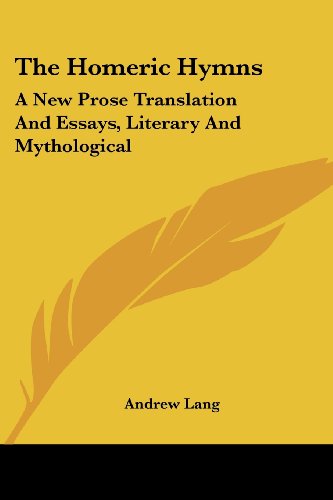
The Homeric Hymns Andrew Lang
Nuestros clientes opinan:


También disponible como:
The Homeric Hymns
Andrew Lang
"The existing collection of the Hymns is of unknown editorship, unknown date, and unknownpurpose," says Baumeister. Why any man should have collected the little preludes of five or six linesin length, and of purely conventional character, while he did not copy out the longer poems towhich they probably served as preludes, is a mystery. The celebrated Wolf, who opened the pathwhich leads modern Homerologists to such an extraordinary number of divergent theories, thoughtrightly that the great Alexandrian critics before the Christian Era, did not recognise the Hymns as"Homeric." They did not employ the Hymns as illustrations of Homeric problems; though it iscertain that they knew the Hymns, for one collection did exist in the third century B. C.{4} Diodorus and Pausanias, later, also cite "the poet in the Hymns," "Homer in the Hymns"; andthe pseudo-Herodotus ascribes the Hymns to Homer in his Life of that author. Thucydides, in thePericlean age, regards Homer as the blind Chian minstrel who composed the Hymn to the DelianApollo: a good proof of the relative antiquity of that piece, but not evidence, of course, that ourwhole collection was then regarded as Homeric. Baumeister agrees with Wolf that the brief Hymnswere recited by rhapsodists as preludes to the recitation of Homeric or other cantos. Thus, in Hymnxxxi. 18, the poet says that he is going on to chant "the renowns of men half divine." Otherpreludes end with a prayer to the God for luck in the competition of reciters.
| Medios de comunicación | Libros Paperback Book (Libro con tapa blanda y lomo encolado) |
| Publicado | 22 de enero de 2021 |
| ISBN13 | 9798560316556 |
| Páginas | 50 |
| Dimensiones | 152 × 229 × 3 mm · 81 g |
| Lengua | Inglés |
Mas por Andrew Lang
Mostrar todo


![Cover for Andrew Lang · History of English Literature from Beowulf to Swinburne (Paperback Book) [2nd edition] (2025)](https://imusic.b-cdn.net/images/item/original/292/9780809532292.jpg?andrew-lang-2025-history-of-english-literature-from-beowulf-to-swinburne-paperback-book&class=scaled&v=1416844540)











Más de esta serie

Ver todo de Andrew Lang ( Ej. Paperback Book , Hardcover Book , Book , CD y Audiolibro (CD) )