
Recomienda este artículo a tus amigos:
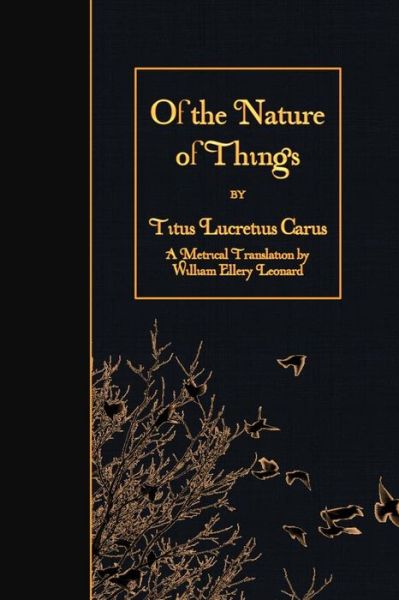
On The Nature Of Things Titus Lucretius Carus
Pedido desde almacén remoto
 Los regalos de Navidad se podrán canjear hasta el 31 de enero

Nuestros clientes opinan:


También disponible como:
On The Nature Of Things
Titus Lucretius Carus
The lengthy poem, On the Nature of Things, by Lucretius, published as De Rerum Natura in Latin, presents the Greek philosopher Epicurus's scientific theory. The title of Lucretius's work, Peri physes, is a translation of the title of Epicurus' principal treatise (On Nature). Lucretius structured his discussion into six books, each of which had a very well-crafted introduction. Books I and II lay forth the fundamental ideas of the atomic universe, disprove the competing views of Heracleitus, Empedocles, and Anaxagoras, pre-Socratic cosmic thinkers, and subtly criticize the Stoics, a rival school of moralists to Epicurus. The final sermon in Book III, "Death is nothing to us," illustrates the atomic structure of the soul and its mortality. Book IV criticizes sexual passion while describing the mechanisms of the mind, some physical functions, and sense perception. Book V explains how the world and heavenly bodies were created, how they function, how life evolved, and how human society developed. Book VI covers amazing astronomical and terrestrial events, especially lightning and thunder. The poem concludes with a description of the Athens epidemic, a sombre representation of mortality in contrast to the image of spring and life presented in the poem's opening appeal to Venus.
| Medios de comunicación | Libros Paperback Book (Libro con tapa blanda y lomo encolado) |
| Publicado | 2023 |
| ISBN13 | 9789357481854 |
| Editores | Double 9 Books |
| Páginas | 330 |
| Dimensiones | 140 × 212 × 26 mm · 362 g |
| Lengua | Inglés |






![Cover for Titus Lucretius Carus · De Rerum Natura (Paperback Book) [Latin edition] (2013)](https://imusic.b-cdn.net/images/item/original/970/9781909669970.jpg?titus-lucretius-carus-2013-de-rerum-natura-paperback-book&class=scaled&v=1409972842)





![Cover for Titus Lucretius Carus · Lucretius: Selections from the De Rerum Natura - Latin Texts (Paperback Book) [New edition] (2011)](https://imusic.b-cdn.net/images/item/original/869/9781853994869.jpg?titus-lucretius-carus-2011-lucretius-selections-from-the-de-rerum-natura-latin-texts-paperback-book&class=scaled&v=1408630763)


