Recomienda este artículo a tus amigos:
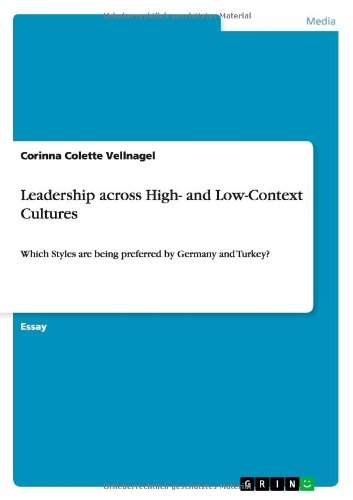
Leadership Across High- and Low-context Cultures Corinna Colette Vellnagel
Pedido desde almacén remoto
Nuestros clientes opinan:


Leadership Across High- and Low-context Cultures
Corinna Colette Vellnagel
Essay from the year 2011 in the subject Communications - Interpersonal Communication, grade: Outstanding, The University of Surrey, language: English, abstract: When you think of great leaders, names like Nelson Mandela, Martin Luther King, Bill Gates, Barack Obama or Gordon Brown may come up. But what makes a leader a good leader? Being a good leader requires a lot of things and therefore not everybody can be a successful leader. "Leaders can be born, elected, or trained and groomed; they can seize power or have leadership trust upon them" (Lewis: 2006, p.104). They can be democratic or autocratic, individual or collective, ascribed or merit-based, imposed or desired (Lewis: 2006). Consequently, there is no such thing as a perfect leadership style which works in every situation and with all followers; there usually is no ideal way of leading - there is only a better or worse way (Larkin: 2008). That is one of the reasons why a good leader needs to have the ability to use many different styles in order to succeed (Broadbent, Kitzis: 2005). It is a false conclusion that the well-adopted hard skills of a manager inevitably lead to economic success. Those hard skills form the foundation of a strong, effective and recognized leader, but nowadays further acquirements are an absolute must. Endurance, universalism, knowledge of human nature, communications, collaboration and work input are inevitable (Eckert, Drath: 2009). Additionally to the fact that it is in any case difficult to find the ideal style for every situation and every follower, cultural differences set up another challenge: communication styles, gender, uncertainty avoidance, power distance, individualistic versus collectivistic, etc. play an important role if it comes to finding the most ideal style (Ledlow, Coppola: 2011). Several scientists support the idea of "a culture specific view of leadership indicating that unique cultural" (Pa?a, Kabasakal, Bodur: 2001, p.565) traits such as religion, language and
| Medios de comunicación | Libros Paperback Book (Libro con tapa blanda y lomo encolado) |
| Publicado | 22 de julio de 2011 |
| ISBN13 | 9783640956708 |
| Editores | GRIN Verlag |
| Páginas | 60 |
| Dimensiones | 146 × 4 × 207 mm · 62 g |
| Lengua | Alemán |
Mas por Corinna Colette Vellnagel
Mostrar todo![Cover for Corinna Colette Vellnagel · Cross-Cultural Brand Personality and Brand Desirability: An Empirical Approach to the Role of Culture on this Mediated Interplay - Markenkommunikation und Beziehungsmarketing (Paperback Book) [1st ed. 2020 edition] (2020)](https://imusic.b-cdn.net/images/item/original/773/9783658311773.jpg?corinna-colette-vellnagel-2020-cross-cultural-brand-personality-and-brand-desirability-an-empirical-approach-to-the-role-of-culture-on-this-mediated-interplay-markenkommunikation-und-beziehungsmarketing-paperback-book&class=scaled&v=1602177529)


Ver todo de Corinna Colette Vellnagel ( Ej. Paperback Book y Book )