Recomienda este artículo a tus amigos:
Expressionist Style in Fritz La Seiwald
Pedido desde almacén remoto
Nuestros clientes opinan:


Expressionist Style in Fritz La
Seiwald
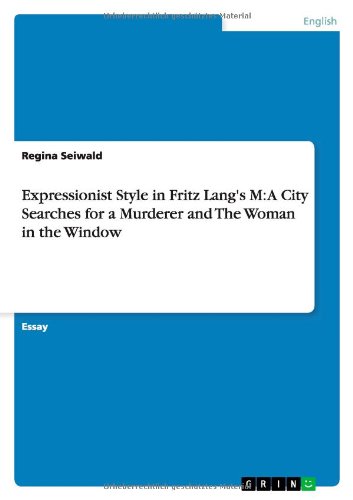
Essay from the year 2010 in the subject English Language and Literature Studies - Literature, grade: Sehr Gut, University of Birmingham (School of English), course: Film: Narrative, Meaning and Representation , language: English, comment: This is a well written, excellently presented, carefully researched and intelligent essay, demonstrating a high level of sophistication and knowledge on the subject of German Expressionism in the films of Fritz Lang. The grasp of aesthetic issues and ability to write about this cogently is very impressive. , abstract: Fritz Lang's films are influenced by German Expressionism, which originated in Germany in 1919 and ended in 1930. Extreme stylised mise-en-scène is employed to make the formal organisation of the films obvious (Cook 1999, p. 67). The main concern of German Expressionist films is to create a phantasy world, which is in stark contrast to the real world in order to reflect upon social grievances and chasms: Expressionism [...] is a reaction against the atom-splitting of Impressionism, which reflects the iridescent ambiguities, disquieting diversity, and ephemeral hues of nature. At the same time Expressionism sets itself against Naturalism with its mania for recording mere facts, and its paltry aim of photographing nature or daily life. The world is there for all to see; it would be absurd to reproduce it purely and simply as it is. (Eisner 1969, p. 10) This is especially evident in Fritz Lang's revolutionary filming technique as the employed shot types and angles enhance angst and paranoia in the spectator. M and The Woman in the Window are also influenced by so-called 'Kammerspiel'-films of the 1920s, through which a new psychological realism emerged. The introduction of sound made it possible for Lang to represent the individual psyche through the character's speech. Fritz Lang uses universal symbols as a bridge between the character's inner state and the outer world. This also derives from German Expressionism, whi
| Medios de comunicación | Libros Book |
| Publicado | 27 de enero de 2011 |
| ISBN13 | 9783640812240 |
| Editores | GRIN Verlag GmbH |
| Páginas | 32 |
| Dimensiones | 138 × 20 × 213 mm · 250 g (Peso (estimado)) |
| Lengua | Alemán |
![Cover for Seiwald · Das Frauenbild in Erich Kästner (Book) [German edition] (2013)](https://imusic.b-cdn.net/images/item/original/432/9783638935432.jpg?seiwald-2013-das-frauenbild-in-erich-kastner-book&class=scaled&v=1749586092)
