
Recomienda este artículo a tus amigos:
Aesop Fables: {Illustrated}


Aesop Fables: {Illustrated}
Aesop
Publisher Marketing: Aesop embodies an epigram not uncommon in human history; his fame is all the more deserved because he never deserved it. The firm foundations of common sense, the shrewd shots at uncommon sense, that characterise all the Fables, belong not him but to humanity. In the earliest human history whatever is authentic is universal: and whatever is universal is anonymous. In such cases there is always some central man who had first the trouble of collecting them, and afterwards the fame of creating them. He had the fame; and, on the whole, he earned the fame. There must have been something great and human, something of the human future and the human past, in such a man: even if he only used it to rob the past or deceive the future. The story of Arthur may have been really connected with the most fighting Christianity of falling Rome or with the most heathen traditions hidden in the hills of Wales. But the word "Mappe" or "Malory" will always mean King Arthur; even though we find older and better origins than the Mabinogian; or write later and worse versions than the "Idylls of the King." The nursery fairy tales may have come out of Asia with the Indo-European race, now fortunately extinct; they may have been invented by some fine French lady or gentleman like Perrault: they may possibly even be what they profess to be. But we shall always call the best selection of such tales "Grimm's Tales" simply because it is the best collection. The historical Aesop, in so far as he was historical, would seem to have been a Phrygian slave, or at least one not to be specially and symbolically adorned with the Phrygian cap of liberty. He lived, if he did live, about the sixth century before Christ, in the time of that Croesus whose story we love and suspect like everything else in Herodotus. There are also stories of deformity of feature and a ready ribaldry of tongue: stories which (as the celebrated Cardinal said) explain, though they do not excuse, his having been hurled over a high precipice at Delphi. It is for those who read the Fables to judge whether he was really thrown over the cliff for being ugly and offensive, or rather for being highly moral and correct. But there is no kind of doubt that the general legend of him may justly rank him with a race too easily forgotten in our modern comparisons: the race of the great philosophic slaves. Aesop may have been a fiction like Uncle Remus: he was also, like Uncle Remus, a fact. It is a fact that slaves in the old world could be worshipped like Aesop, or loved like Uncle Remus. It is odd to note that both the great slaves told their best stories about beasts and birds. But whatever be fairly due to Aesop, the human tradition called Fables is not due to him. This had gone on long before any sarcastic freedman from Phrygia had or had not been flung off a precipice; this has remained long after. It is to our advantage, indeed, to realise the distinction; because it makes Aesop more obviously effective than any other fabulist. Grimm's Tales, glorious as they are, were collected by two German students. And if we find it hard to be certain of a German student, at least we know more about him than We know about a Phrygian slave. The truth is, of course, that Aesop's Fables are not Aesop's fables, any more than Grimm's Fairy Tales were ever Grimm's fairy tales. But the fable and the fairy tale are things utterly distinct. There are many elements of difference; but the plainest is plain enough. There can be no good fable with human beings in it. There can be no good fairy tale without them. Review Citations: School Library Journal 02/01/1995 pg. 94 (EAN 9781558583405, Paperback) Hornbook Guide to Children 07/01/1994 pg. 110 (EAN 9781558583405, Paperback) School Library Journal 02/01/1995 pg. 94 (EAN 9781558583399, Hardcover) Publishers Weekly 12/05/1994 pg. 76 (EAN 9781558583399, Hardcover) Hornbook Guide to Children 07/01/1994 pg. 110 (EAN 9781558583399, Hardcover) School Library Journal 10/01/1992 pg. 101 (EAN 9780152003500, Hardcover) Hornbook Guide to Children 01/01/1991 (EAN 9780152003500, Hardcover) Hornbook Guide to Children 01/01/1992 (EAN 9780152003500, Hardcover) Publishers Weekly 11/23/1992 (EAN 9780152003500, Hardcover) Wilson Children's Catalog 96 01/01/1996 pg. 85 (EAN 9780140548723, Mass Market Paperbound) Library Journal 03/15/1993 (EAN 9780813118123, Hardcover) Kirkus Reviews 11/01/2013 (EAN 9789888240524, Hardcover) School Library Journal 01/01/2014 pg. 111 (EAN 9789888240524, Hardcover) Bulletin of Ctr for Child Bks 01/01/2014 pg. 254 (EAN 9789888240524, Hardcover) School Library Journal 09/01/2014 pg. 165 (EAN 9781454910978, Hardcover) Hornbook Guide to Children 01/01/1992 (EAN 9780671741174, Hardcover) Contributor Bio: Aesop Aesop (620-560 BC) was a slave in ancient Greece who is known only for the genre of fables that are ascribed to him. Contributor Bio: Chesterton, G K G. K. Chesterton (1874 - 1936) Gilbert Keith Chesterton, KC*SG (29 May 1874 - 14 June 1936) better known as G. K. Chesterton was an English writer. He wrote on philosophy, ontology, poetry, plays, journalism, public lectures and debates, literary and art criticism, biography, Christian apologetics, and fiction, including fantasy and detective fiction. Chesterton is often referred to as the "prince of paradox." Time magazine, in a review of a biography of Chesterton, observed of his writing style: "Whenever possible Chesterton made his points with popular sayings, proverbs, allegories-first carefully turning them inside out." Chesterton is well known for his reasoned apologetics, and even some of those who disagree with him have recognized the universal appeal of such works as Orthodoxy and The Everlasting Man. Chesterton, as a political thinker, cast aspersions on both Progressivism and Conservatism, saying, "The whole modern world has divided itself into Conservatives and Progressives. The business of Progressives is to go on making mistakes. The business of the Conservatives is to prevent the mistakes from being corrected.
| Medios de comunicación | Libros Paperback Book (Libro con tapa blanda y lomo encolado) |
| Publicado | 5 de junio de 2014 |
| ISBN13 | 9781499798838 |
| Editores | Createspace Independent Publishing Platf |
| Páginas | 308 |
| Dimensiones | 133 × 203 × 18 mm · 354 g |
| Traductor | Jones, Vernon (Lewis and Clark College) |
Mas por Aesop
Mostrar todo![Cover for Aesop · Aesop's Fables - Word Cloud Classics (Paperback Book) [2nd edition] (2025)](https://imusic.b-cdn.net/images/item/original/579/9781667209579.jpg?aesop-2025-aesop-s-fables-word-cloud-classics-paperback-book&class=scaled&v=1727112625)








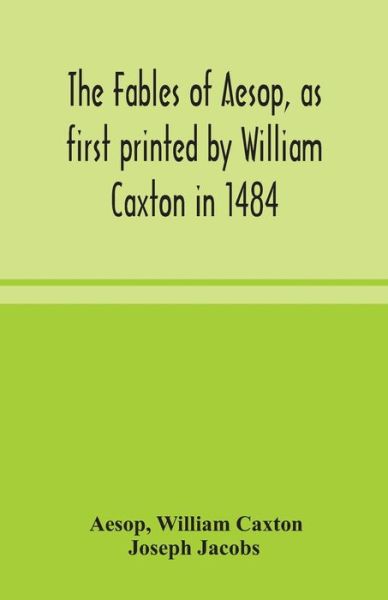


![Cover for Aesop · THE Aesop's Fables (Paperback Book) [Illustrated edition] (2019)](https://imusic.b-cdn.net/images/item/original/458/9788026892458.jpg?aesop-2019-the-aesop-s-fables-paperback-book&class=scaled&v=1642661944)

Ver todo de Aesop ( Ej. Paperback Book , Hardcover Book , Book , CD y Board book )