
Recomienda este artículo a tus amigos:
Gulliver's Travels Jonathan Swift
Nuestros clientes opinan:


También disponible como:
-
Paperback BookReprint edition(2008) $ 10,49
- Paperback Book (2003) $ 11,49
- Paperback Book (2024) $ 12,49
- Paperback Book (2025) $ 12,49
- Book (2018) $ 13,99
- Book (2016) $ 14,49
- Paperback Book (2023) $ 14,49
- Paperback Book (2014) $ 14,49
- Paperback Book (2017) $ 14,99
- Paperback Book (2017) $ 14,99
- Paperback Book (2015) $ 14,99
- Book (2017) $ 14,99
- Paperback Book (2016) $ 15,99
-
Paperback BookReprint edition(2010) $ 15,99
- Paperback Book (2014) $ 15,99
- Paperback Book (2010) $ 15,99
- Book (2017) $ 15,99
- Paperback Book (2017) $ 15,99
- Paperback Book (2017) $ 15,99
- Paperback Book (2018) $ 16,49
- Paperback Book (2017) $ 16,49
- Book (2018) $ 16,49
- Paperback Book (2025) $ 16,99
- Paperback Book (2012) $ 17,49
- Paperback Book (2017) $ 17,49
Gulliver's Travels
Jonathan Swift
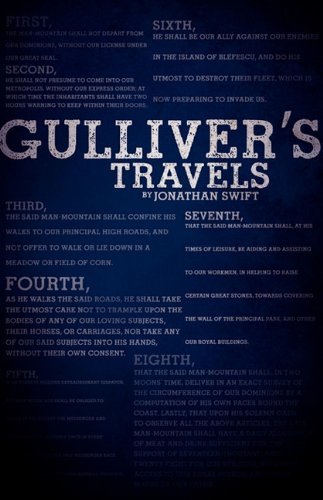
Publisher Marketing: This collector-quality Summit Classics edition of Jonathan Swift's satirical masterpiece includes the complete text of Swift's timeless classic tale of the adventures of Lemuel Gulliver in a variety of strange lands in a freshly edited and newly typeset edition, faithfully following the text of the second edition authorized by Swift, in which many of the passages deleted by the original publisher were restored. With a generous 6x9 page size, this edition is printed on heavyweight bright white paper with a fully laminated cover featuring an original full color design. Page headers, an expanded detailed table of contents for quick location of specific episodes, proper placement of footnotes and page design reflecting the classic values of book publishing exemplify the attention to detail given this volume. Jonathan Swift (1667-1745), Irish clergyman, author, journalist, and political activist, originally published his masterpiece in 1726. An instant success throughout the British Empire, it cemented Swift's reputation as a writer and social commentator. The work's merciless lampooning of the petty, pompous and ignorant pretensions and foolishness of people and their political leaders has made it a timeless classic, a commentary on human nature no less apt today than the day it was published. Often reprinted and adapted, some versions have been poorly done, treating it as a simple story for children and, more frequently, truncating the tale and presenting only the visit to Lilliput as if it were the whole book. In fact, Gulliver, a ship's doctor and later captain of his own ship, goes on four separate voyages and visits a series of strange lands, each of which exposes him to new perspectives on life and each of which provides Swift with a vehicle for satirizing aspects of human nature and English society. The first voyage, almost universally familiar, is to Lilliput, a land inhabited by tiny men to whom Gulliver is a giant. While the Lilliputians initially seem amiable and reasonable, once over their fear of Gulliver they are gradually exposed as ridiculous and petty creatures. The second voyage takes Gulliver to Brobdingnag, where the tables are turned and Gulliver seems tiny in a land of giants. At first as afraid of the giants as the Lilliputians were of him, Gulliver finds the giants to be surprisingly gentle. He is humiliated as he realizes, while trying to explain English society, how flawed it is, and comes to understand how grotesque he must have seemed to the Lilliputians. Gulliver's third voyage takes him to lands where he is able to summon the dead, discovering historical deceptions, encounters a race of deep thinkers who have no common sense or practical skills, and finds another race who are miserably unhappy despite, or because of, their immortality. The fourth voyage is to the land of the Houyhnhnms, intelligent horses endowed with reason and language. Their society is orderly, rational, clean, and simple, in stark contrast to the filth, ignorance and brutality of the Yahoos, beasts in human form. Slowly, and reluctantly, Gulliver realizes that the Yahoos are human in more than just physical resemblance. Attributed to Lemuel Gulliver when originally published, the work takes the form of a narrative received from Gulliver by a cousin, who is authorized to do as he sees best with it. Swift's original manuscript was given to a London publisher who paled at some of the more politically incendiary passages and actually edited the text before printing it. The original manuscript was then burned, perhaps to conceal Swift's handwriting from the authorities or perhaps to prevent the publisher's being caught in possession of the original. The purported letter from Gulliver to his cousin which appears in this edition was not part of the original printing, and is actually a thinly disguised list of Swift's complaints rebuking the original publisher for what Swift saw as shortcomings in the first edition. Contributor Bio: Swift, Jonathan Born in 1667, Jonathan Swift was an Irish writer and cleric, best known for his works Gulliver's Travels, A Modest Proposal, and A Journal to Stella, amongst many others. Educated at Trinity College in Dublin, Swift received his Doctor of Divinity in February 1702, and eventually became Dean of St. Patrick's Cathedral in Dublin. Publishing under the names of Lemeul Gulliver, Isaac Bickerstaff, and M. B. Drapier, Swift was a prolific writer who, in addition to his prose works, composed poetry, essays, and political pamphlets for both the Whigs and the Tories, and is considered to be one of the foremost English-language satirists, mastering both the Horatian and Juvenalian styles. Swift died in 1745, leaving the bulk of his fortune to found St. Patrick's Hospital for Imbeciles, a hospital for the mentally ill, which continues to operate as a psychiatric hospital today.
| Medios de comunicación | Libros Paperback Book (Libro con tapa blanda y lomo encolado) |
| Publicado | 3 de noviembre de 2012 |
| ISBN13 | 9781480194991 |
| Editores | Createspace |
| Páginas | 248 |
| Dimensiones | 152 × 229 × 13 mm · 335 g |
Mas por Jonathan Swift
Mostrar todo

![Cover for Jonathan Swift · Gulliver's Travels [school Edition Edited and Annotated by Thomas M. Balliet] (Paperback Book) (2025)](https://imusic.b-cdn.net/images/item/original/839/9781557424839.jpg?jonathan-swift-2025-gulliver-s-travels-school-edition-edited-and-annotated-by-thomas-m-balliet-paperback-book&class=scaled&v=1409976846)






![Cover for Jonathan Swift · Gulliver (Paperback Book) [2 New edition] (2022)](https://imusic.b-cdn.net/images/item/original/420/9781788493420.jpg?jonathan-swift-2022-gulliver-paperback-book&class=scaled&v=1651134528)















Más de esta serie
![Cover for Jonathan Swift · Gulliver's Travels (Everyman's Library (Cloth)) (Hardcover Book) [Reprint edition] (1991)](https://imusic.b-cdn.net/images/item/original/450/9780679405450.jpg?jonathan-swift-1991-gulliver-s-travels-everyman-s-library-cloth-hardcover-book&class=scaled&v=1448740238)

![Cover for Jonathan Swift · Gulliver's Travels (Royal Collector's Edition) (Case Laminate Hardcover with Jacket) (Hardcover Book) [Royal Collector's edition] (2020)](https://imusic.b-cdn.net/images/item/original/864/9781774760864.jpg?jonathan-swift-2020-gulliver-s-travels-royal-collector-s-edition-case-laminate-hardcover-with-jacket-hardcover-book&class=scaled&v=1651963695)


![Cover for Jonathan Swift · Gulliver's Travels - Flame Tree Collectable Classics (Hardcover Book) [New edition] (2024)](https://imusic.b-cdn.net/images/item/original/891/9781804177891.jpg?jonathan-swift-2024-gulliver-s-travels-flame-tree-collectable-classics-hardcover-book&class=scaled&v=1690710158)
![Cover for Jonathan Swift · Gulliver's Travels - Macmillan Collector's Library (Hardcover Book) [New edition] (2017)](https://imusic.b-cdn.net/images/item/original/213/9781509843213.jpg?jonathan-swift-2017-gulliver-s-travels-macmillan-collector-s-library-hardcover-book&class=scaled&v=1510031541)

![Cover for Jonathan Swift · Gulliver's Travels - Penguin Clothbound Classics (Hardcover Book) [Ed edition] (2010)](https://imusic.b-cdn.net/images/item/original/640/9780141196640.jpg?jonathan-swift-2010-gulliver-s-travels-penguin-clothbound-classics-hardcover-book&class=scaled&v=1424369867)

![Cover for Jonathan Swift · Gulliver's Travels - The Cambridge Edition of the Works of Jonathan Swift (Hardcover Book) [New edition] (2012)](https://imusic.b-cdn.net/images/item/original/641/9780521841641.jpg?jonathan-swift-2012-gulliver-s-travels-the-cambridge-edition-of-the-works-of-jonathan-swift-hardcover-book&class=scaled&v=1396655203)
![Cover for Jonathan Swift · Gulliver's Travels - The Penguin English Library (Paperback Book) [Ed edition] (2012)](https://imusic.b-cdn.net/images/item/original/989/9780141198989.jpg?jonathan-swift-2012-gulliver-s-travels-the-penguin-english-library-paperback-book&class=scaled&v=1399149728)











Ver todo de Jonathan Swift ( Ej. Paperback Book , Hardcover Book , Book , CD y ePUB )