
Recomienda este artículo a tus amigos:
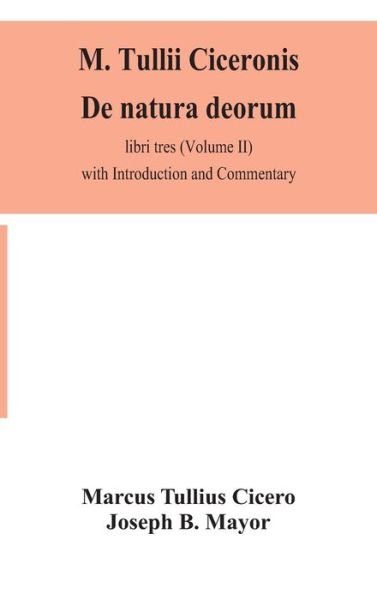
M. Tullii Ciceronis De Natura Deorum Libri Tres Marcus Tullius Cicero Latin edition


M. Tullii Ciceronis De Natura Deorum Libri Tres
Marcus Tullius Cicero
This historic book may have numerous typos and missing text. Purchasers can download a free scanned copy of the original book (without typos) from the publisher. Not indexed. Not illustrated. 1885 Excerpt: ...differing in substance. What difference is there between associating mind with water, or water with mind? The logical train of thought under Schoemann's supposition would be: Si di possunt &c., deum (not mentem) cur aquae adiunxit; si mens constare &c., mentem cur aquae adiunxit. It is of course not possible to say what Cicero really wrote; but we should prefer to read: Si di possunt esse sine sensu, mentem cur aquae adiunxit, si ipsa mens &c. The edd. and Ms. O have sensu et mente cur aquae adiunxit; and B1 (Orelli) has mentem for mente. A. Weidner (Philologus, Vol. 38, 1879) emends thus: Sed nec di possunt esse sine sensu, et menlem cur aquae adiunxit &c. 40. 15. An,iiniandri, also of Miletus, an Ionic philosopher, born about B. C. 611. He held the existence of a primeval substance, apxri, which he called aneipov. It was undefined in quality and unlimited in extent. There is a difference of opinion whether he considered the aeipov to be a mixture of all the elementary substances which in time separated and assumed distinct existence, or an indefinite substance which potentially contained all the others. Aristotle, Phys. III, 4, says that he taught that the aireipov was itself divine, contained and governed everything. It is probable however that Anaximander did not express himself very clearly on these points. He is said to have taught that the soul was of the nature of air. See Ueberweg, Gesch. der Phil. I, p. 36.--natlvos esse deos, i.e. that the gods had not always existed, but had come into existence in the course of the development of the universe. Comp. Schwegler on Arist. Metaph. XII, 2, 5, p. 239. 40. 16. innumerabilis mundos. Apparently not only the heavenly bodies are here meant, which, as we know, Anaxagoras held to be gods, but ...
| Medios de comunicación | Libros Hardcover Book (Libro con lomo y cubierta duros) |
| Publicado | 10 de abril de 2009 |
| ISBN13 | 9781103972364 |
| Editores | BiblioLife |
| Páginas | 352 |
| Dimensiones | 230 × 20 × 153 mm · 666 g |
| Lengua | Inglés Latin |
Mas por Marcus Tullius Cicero
Mostrar todo

![Cover for Marcus Tullius Cicero · Om venskab (Hardcover Book) [1.º edición] (2025)](https://imusic.b-cdn.net/images/item/original/933/9788797549933.jpg?marcus-tullius-cicero-2025-om-venskab-hardcover-book&class=scaled&v=1761917344)






![Cover for Marcus Tullius Cicero · Second Oration of Cicero Against Catiline [microform] (Hardcover Book) (2021)](https://imusic.b-cdn.net/images/item/original/886/9781013878886.jpg?marcus-tullius-cicero-2021-second-oration-of-cicero-against-catiline-microform-hardcover-book&class=scaled&v=1641290068)



![Cover for Marcus Tullius Cicero · How to Grow Old and a Guide to Friendship (Royal Collector's Edition) (Case Laminate Hardcover with Jacket) (Hardcover Book) [Royal Collector's edition] (2021)](https://imusic.b-cdn.net/images/item/original/670/9781774761670.jpg?marcus-tullius-cicero-2021-how-to-grow-old-and-a-guide-to-friendship-royal-collector-s-edition-case-laminate-hardcover-with-jacket-hardcover-book&class=scaled&v=1643010960)



Ver todo de Marcus Tullius Cicero ( Ej. Paperback Book , Hardcover Book , Book , CD y Map )